
AI FOR CUSTOMER INSIGHTS: WHAT CANADIAN MANAGERS ARE REALLY DOING WITH IT.
.

AI adoption for customer insights has moved fast. In the span of a few years, tools that once required dedicated data teams are now accessible to any manager with a browser and a question.
The conversation has shifted from “Should we use AI for this?” to “How much should we rely on it?”
That shift is real, but it’s happening unevenly.
Not every company is using AI the same way, trusting it the same way, or getting the same results from it. And the gap between what AI can deliver and what companies are actually doing with it is wider than the adoption headlines suggest.
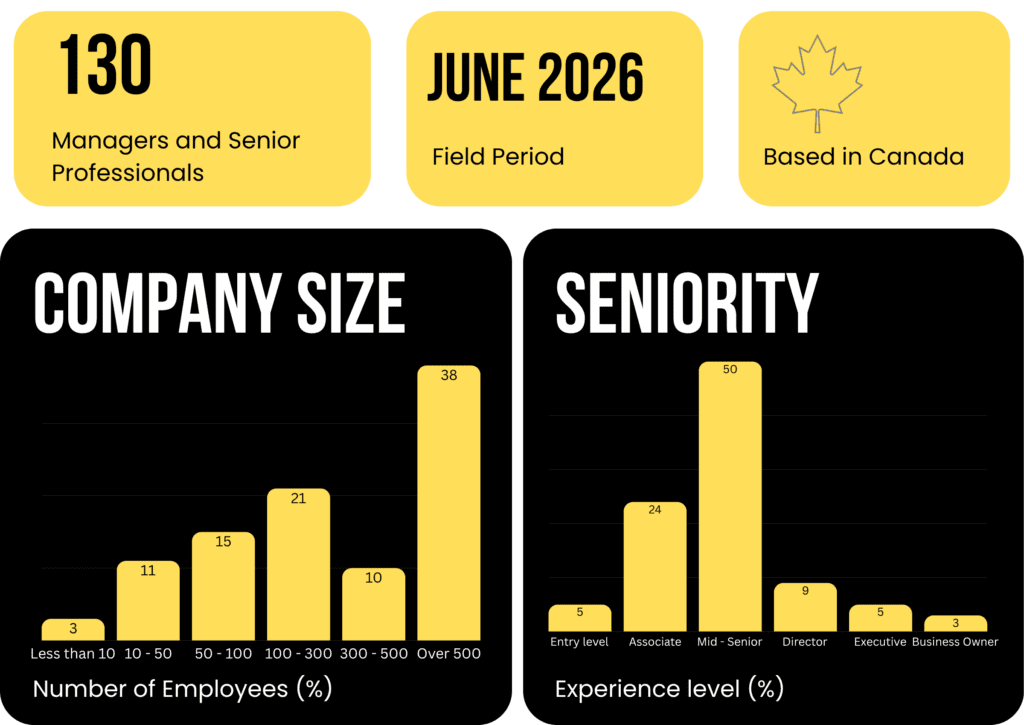
To understand what’s really happening inside Canadian organizations, we surveyed 130 managers and senior professionals in June 2026. What follows is what they told us
at a glance
WHICH AI TOOLS DO CANADIAN MANAGERS USE MOST?
ChatGPT leads by a wide margin, used by 40% of managers, followed by Microsoft Copilot (27%) and Google Gemini (21%). Claude trails at 5%.
The dominance of general-purpose assistants over specialized customer insights platforms suggests that, for many companies, AI-assisted customer understanding is still happening through general tools adapted to the task, not dedicated software built for it.
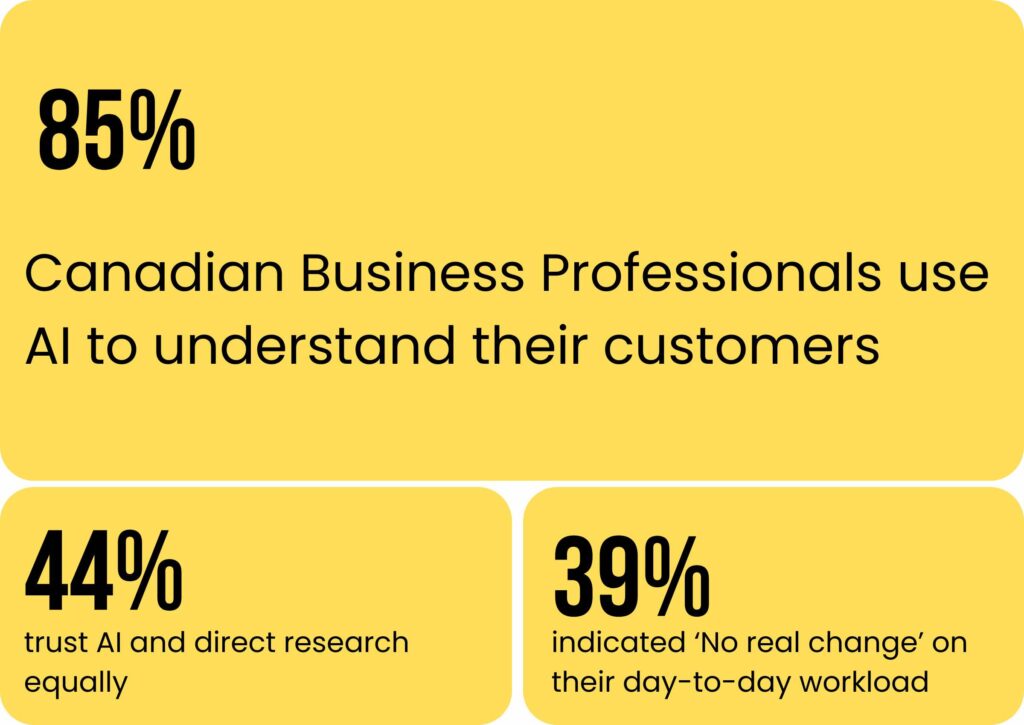
That’s likely to shift as the market matures, but it’s worth noting for now: most of the 85% adoption figure reflects flexible, general AI use, not purpose-built customer insights infrastructure.
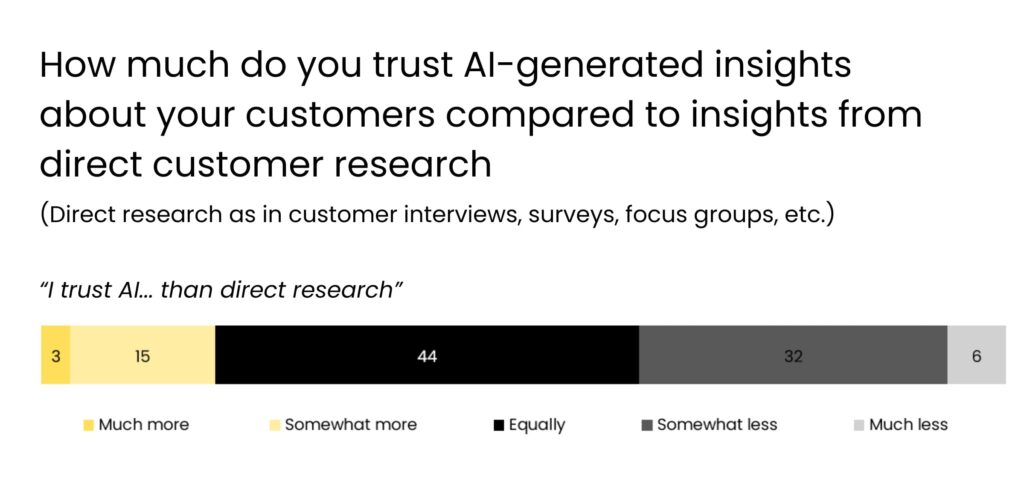
When we asked managers how much they trust AI-generated insights compared to what they’d get from a direct conversation with a customer, the answers were more nuanced than the adoption numbers might suggest.
44% said they trust both equally, and almost 20% said they lean toward AI over direct research methods such as interviews, surveys, and focus groups.
“Nothing replaces human interactions or experiences, but AI may offer different views or options never thought of” | Male Professional Associate – 59 years old
The top use cases, personalization, feedback analysis, and behavioral patterns, are tasks that build on data and workflows that are already in place. If you have a CRM, a feedback tool, or a transactional database, AI can plug in relatively quickly and start surfacing patterns. The barrier to entry is low, and the payoff is visible fast.
Churn prediction is a different story. It sits at the bottom of the list for a reason. Predicting who is about to leave requires clean historical data, clearly defined retention metrics, and a model trained on what “at risk” actually looks like for that specific business. It’s not a plug-and-play use case.
.
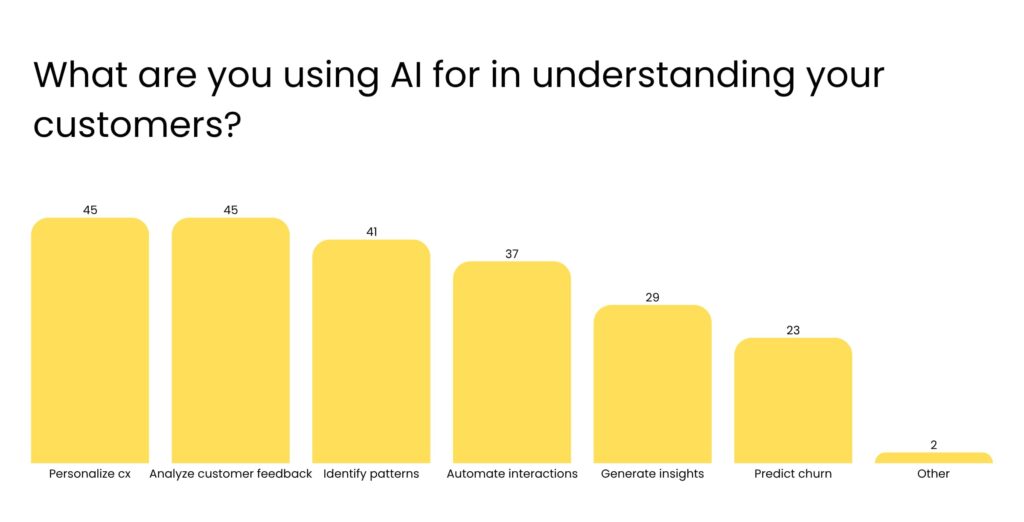
That gap between the top and the bottom of this list is one of the clearest patterns in the data. Most organizations are using AI where it’s easiest to deploy, not necessarily where it would have the most impact.
The sophistication will come, but right now, the majority are still in the early stages of figuring out what AI can actually do for their customer understanding work
Not every company has made the leap. According to our study, 15% of Canadian managers and senior professionals haven’t incorporated AI into their customer understanding processes at all. And their reasons vary more than you’d expect.
It would be easy to assume that the holdouts are simply resistant to change, skeptical of the technology, or waiting for someone else to go first.
But the data tells a more nuanced story. The barriers aren’t uniform, and neither are the motivations behind them.
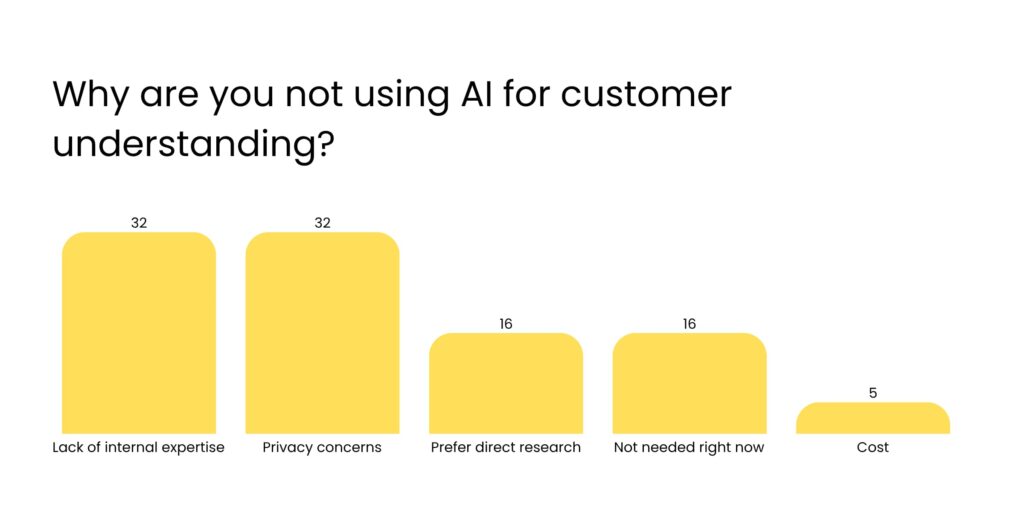
What stands out is that the
two leading reasons
, lack of expertise and privacy concerns, point to very different problems.
One is a
capability gap
that can be closed with training, hiring, or the right tools. The other is a
values-based concern that isn’t going away
as AI becomes more embedded in business workflows, and may actually intensify as regulations around data privacy continue to evolve in Canada.
The 16% who prefer direct research methods are a different group entirely. They’re not blocked by expertise or worried about compliance. They’ve made a deliberate choice to keep humans at the center of their customer understanding process. That’s not resistance. That’s a strategic position.
And the 16% who say AI simply isn’t necessary for their business right now are the most interesting group of all. They may be right. Not every company is at a stage where AI-driven customer understanding makes sense, and recognizing that is its own form of strategic clarity.
HOW HAS AI CHANGED DAY-TO-DAY WORKLOAD?
One of the most persistent assumptions about AI is that it saves time. And for some managers, it does. But the workload picture is more complicated than that narrative suggests.
The largest group, 40%, said AI hasn’t moved the needle either way. They’ve adopted the tools, they’re using them, and their day-to-day workload looks roughly the same as it did before. That’s not a failure, but it’s also not the efficiency gain that most AI adoption stories promise.
For a third of managers, AI has genuinely freed up time (33%). That’s meaningful, and it likely reflects organizations that have invested in integrating AI properly into their workflows, not just bolting it on top of existing processes.
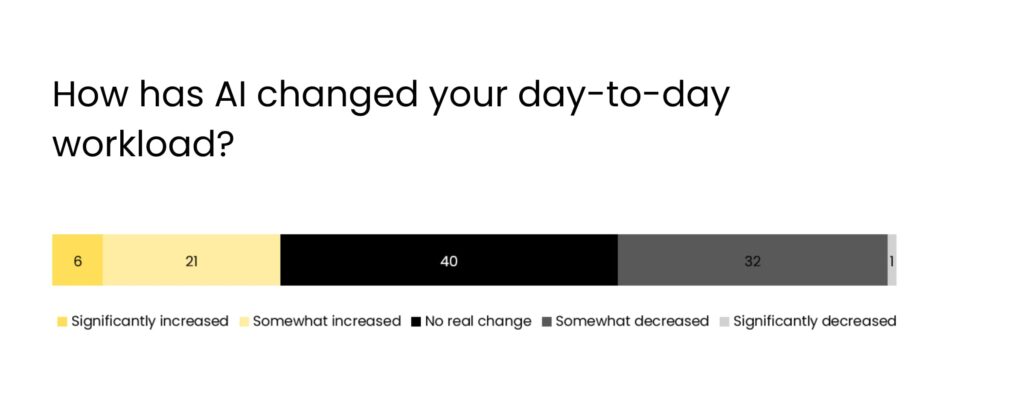
If your team adopted AI and workload hasn’t dropped, the data says you’re in good company. The efficiency gains are real for some, but they’re not automatic. They tend to come with deliberate integration, not just adoption.
HOW TRANSFORMATIONAL HAS AI BEEN FOR CUSTOMER INSIGHTS TEAMS?
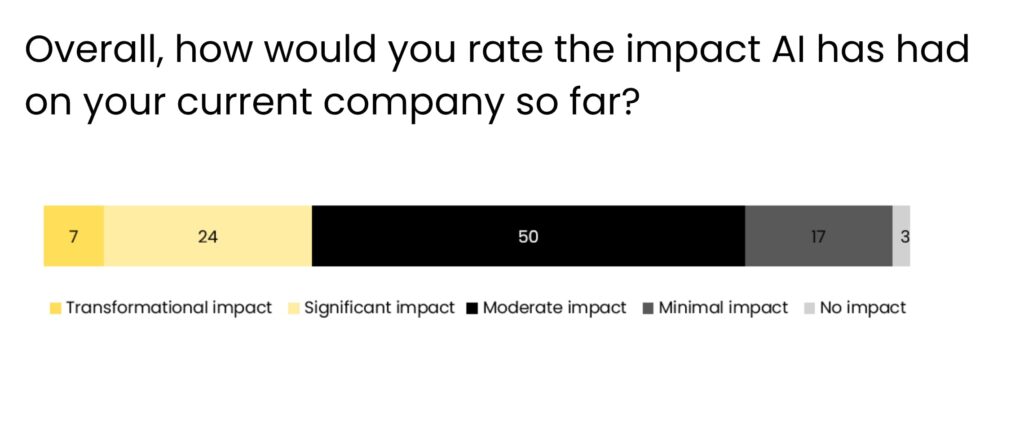
When asked to describe AI’s overall impact on their work, most managers landed in the middle of the scale rather than at the extremes:
WHAT THIS MEANS FOR CUSTOMER INSIGHTS TEAMS
Taken together, these findings describe a tool that’s been adopted widely but unevenly: leaned on heavily for personalization and feedback analysis, still mostly running through general-purpose assistants rather than dedicated platforms, moderate rather than transformational in its impact so far, and still trusted only as much as, not more than, direct research.
AI doesn’t do well is explain the why. It can tell you that a certain segment is churning at a higher rate, but it can’t tell you what that segment is feeling, what triggered the decision, or what would have changed the outcome.
That context comes from a conversation. It comes from a customer interview where someone pauses before answering, or a focus group where one comment shifts the direction of the entire discussion. Those moments don’t show up in a dashboard.
The risk isn’t that companies are replacing qualitative research with AI.
The risk is that as AI becomes easier to deploy and faster to produce outputs, the slower, more deliberate work of talking directly to customers gets quietly deprioritized. Not by decision, but by default.
For companies building or refining their customer insights approach, the useful question isn’t whether to adopt AI. Most already have. It’s where AI is currently pulling its weight, where it isn’t yet, and where direct research still needs to lead.
How Makeable Can Help
Knowing which customer signals to trust, how to interpret what AI is telling you, and when to go deeper with direct research is not always straightforward. At Makeable, we help growing Canadian businesses build the customer insights infrastructure that makes that call easier.
Whether you need help identifying where your AI-generated insights have gaps, designing a qualitative research program to fill them, or building a strategy based on what your customers are actually telling you we are here to help.