

Your Company Uses AI To Understand Customers.
You’re only getting half the picture
According to our AI Reality Check study, conducted in June 2026 with 130 Canadian Managers and Senior professionals, 4 out of 5 (85%) already use AI in some form to understand customers. But when we asked how much they trust those insights, only 18.5% said they trust AI more than direct customer research. Nearly 1 in 5 have already acted on an AI recommendation that backfired
AI is a powerful tool. But it’s only half the picture.
KEY TAKEAWAYS
- 85% of Canadian companies use AI to understand customers
- Nearly 20% trust AI-generated insights more than direct research
- AI tells you what customers do, however it can’t tell you why and the fix isn’t less AI, it’s adding the qualitative layer AI can’t provide
what Canadian companies are actually doing with ai
AI is being used across a wide range of customer-related functions.
These are all quantitative tasks. AI is being used to process, aggregate, and summarize data that already exists. Useful, but only one layer of customer understanding.
According to our study, the most common applications are:
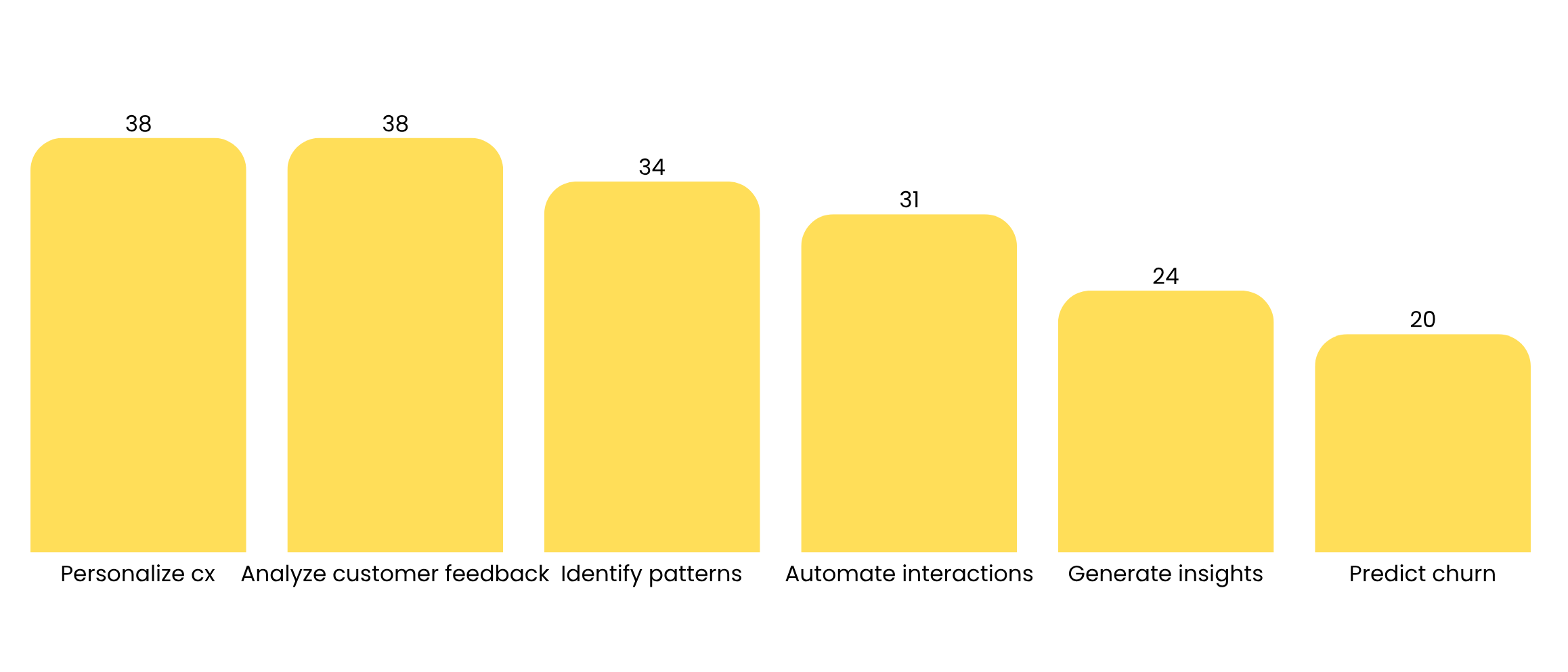
- Personalizing the customer experience (38.5%)
- Analyzing customer feedback (38.5%)
- Identifying patterns in customer behavior (34.6%)
- Automating customer service interactions (31.5%)
- Generating insights from surveys or reviews (24.6%)
- Predicting churn or retention risk (20%)
When we asked managers to compare AI-generated insights to direct customer research (E.g. Interviews, surveys, and focus groups), 43.8% said they trust both equally. But among those who did have a preference, more trusted direct research (37.7%) than AI (18.5%).
And the cost of over-relying on AI is real. 19.2% of managers in our study, close to 1 in 5, said their company implemented an AI-generated recommendation that ended up negatively affecting the business.
“There is some nuances and special cases that AI just won’t be able to directly be accountable for. AI isn’t perfect and it tends to loop, so making it customer facing would be detrimental.”
WHAT AI CAN’T TELL YOU
AI can flag that NPS dropped five points after a product update. What it can’t tell you is which specific change triggered the frustration, or whether it was the product itself or the communication around it.
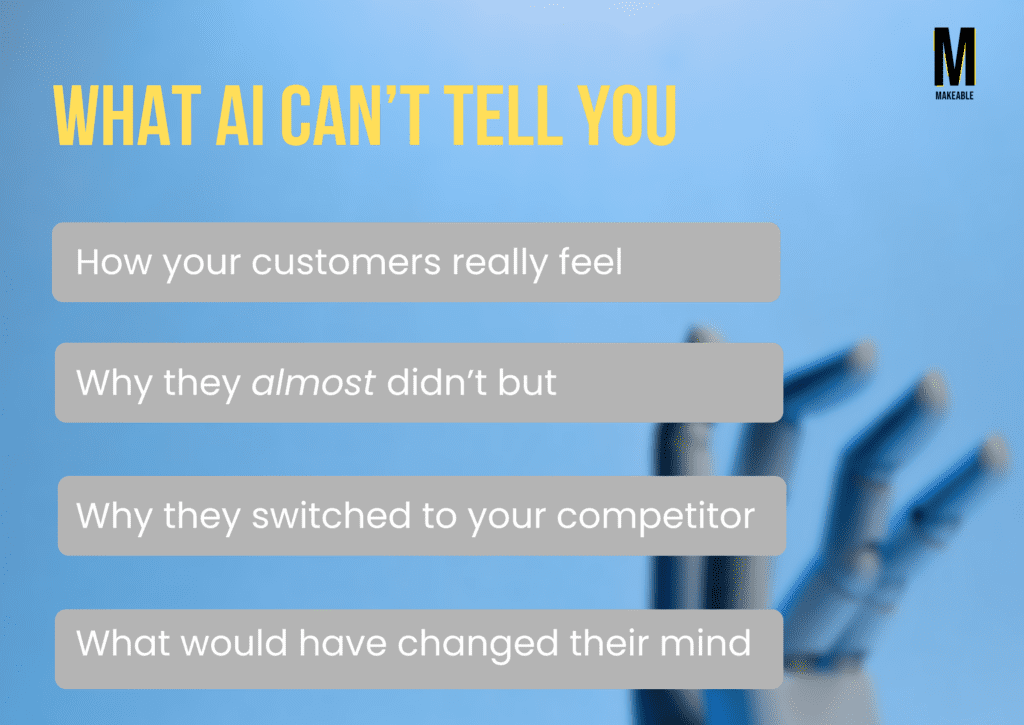
AI can identify that a segment of customers churns at the 90-day mark. What it can’t tell you is whether those customers felt ignored, found a better alternative, or never fully understood the value they were supposed to get.
These are not edge cases. They’re exactly the decisions that determine whether a retention strategy works, whether a product update lands well, and whether a customer experience improvement actually solves the right problem. And they all require the same thing: a conversation with an actual customer.
That context doesn’t live in datasets. It lives in conversations. AI identifies where to look. Direct research tells you what you’re actually looking at.
Customer Interviews
A single well-conducted customer interview surfaces more context than a thousand rows of behavioral data. If your team is seeing a pattern in the data but can’t explain it customers dropping off at a specific point, satisfaction scores moving in an unexpected direction, a segment that doesn’t convert the way it should, that’s exactly what customer interviews are designed to uncover.
We design and conduct in-depth interviews with your current customers, churned customers, or prospects who didn’t convert, to surface the motivations, frustrations, and decision-making logic that no dashboard will show you. The output isn’t just quotes — it’s a clear picture of what’s driving customer behavior, and what would change it.
Focus Groups
Sometimes the question isn’t what one customer thinks, it’s how customers respond to ideas, to each other, and to the language your company uses to describe its own product. Focus groups are the right tool when you’re evaluating a new direction, testing messaging, or trying to understand why a specific segment behaves differently from the rest.
Six to Eight customers in a structured 90-minute session can reveal emotional drivers and shared patterns that quantitative data can only hint at. We design, recruit, and facilitate focus groups tailored to your specific business questions, whether you’re refining a product, rethinking your onboarding, or trying to understand why customers leave.
CX HELATH CHECK
Not sure where the qualitative gap is in your customer experience? That’s often the starting point. Companies know something isn’t working retention is lower than expected, satisfaction scores are flat, a segment isn’t responding the way it should but they’re not sure what to measure or where to look.
Our CX Health Check maps your current customer touchpoints, identifies where decisions are being made on incomplete or AI-only information, and gives you a prioritized plan for building the research infrastructure your team actually needs. It’s the right first step if you want to close the gap between what your data tells you and what your customers are actually experiencing.
THE BOTTOM LINE
AI handles volume. It tells you what is happening across thousands of customers faster than any team can. But the decisions that matter the ones that affect retention, experience, and growth require understanding why. And that still comes from talking to actual people.
Nearly 1 in 5 Canadian managers in our study said their company has already acted on an AI recommendation that backfired. The companies that avoid that outcome aren’t the ones using less AI.
They’re the ones that
know when to pair it with something AI can’t replace.
If your team is relying on AI-generated insights to understand your customers but isn’t sure whether to trust what it’s telling you, we can help you build the qualitative layer that makes those insights actionable.
How Makeable Can Help
Knowing which customer signals to trust, how to interpret what AI is telling you, and when to go deeper with direct research is not always straightforward. At Makeable, we help growing Canadian businesses build the customer insights infrastructure that makes that call easier.
Whether you need help identifying where your AI-generated insights have gaps, designing a qualitative research program to fill them, or building a strategy based on what your customers are actually telling you we are here to help.
This article draws on findings from the AI Reality Check Study, a survey of 130 Canadian managers and Senior Professionals conducted in June 2026.